Writing Exercise: The Angel of Mercy (an American Civil War epic intro for Lauren Brouillette)4/6/2020 Lauren Brouillette runs Pure In Heart Lowell in addition to her day job and just recently played a nurse in our upcoming short film, the Fair Fight. It seemed natural, then, that as a lover of classic novels and classic movies, she would be in some grand epic with sweeping scenery and devastating stakes. Enjoy and let me know what you think! 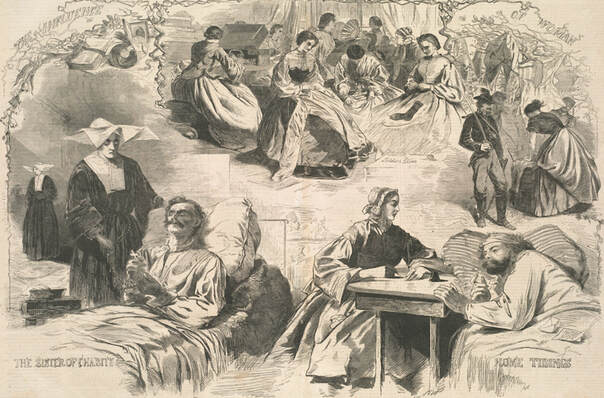 Union Army Medical Camp
Captain Evans finally located Tent 14 and stepped inside. He was at once assaulted by the close heat, the odor, and the sudden lack of light. It took a moment for his eyes to adjust and when they did, he took in the scene before him. Row upon row of beds lined the tent, treated men in all of them. Bandages wrapped heads, eyes, torsos, limbs or the stumps of limbs. Some men were awake and groaning. One man was deliriously fighting the grey-clad nun who gently held him down. It was a nightmarish scene, made the more garish by the obvious attempts at orderly treatment. Evans took off his hat and began to walk down the line, scanning faces and bodies. The uniforms were from a variety of units and ranks. Shrapnel didn’t care what unit you were from or how old you were. He was half way down the miserable line when he came across a body smaller than most – a boy, twelve if he was a day, almost unrecognizable beneath the wrapping. His ruined blue uniform bore the insignia of a drummer. He was moving and moaning and when Evans bent down to listen, he heard one word: “Water…” Evans looked around. The nearest nurse had her back towards him, tenderly applying a fresh bandage to a lanky soldier’s shoulder wound. The man was wincing, his face twisted in tremendous pain, but he was still. Obviously a brave man and Evans might have looked elsewhere when he caught sight of the uniform that clung to the man’s unhurt shoulder. His temper snapped. Evans stalked over. “Nurse,” he barked. The nurse looked up at him without stopping her ministrations. She was a young woman, maybe early twenties, with blonde hair and blue eyes. Her dress was neatly fitted and clean, but worn, her demeanor calmly proficient. Evans’ first impression was that this woman was absolutely capable and completely imperturbable. “Can I help you, Captain?” she asked, politely, neatly finishing her work. Then, to the Confederate, “This will be changed daily, Corporal. I’ll be back later to see how you’re doing.” “Thank you, ma’am,” the man said, his deep voice weakened into a whisper. The drummer boy moaned and Evans’ temper boiled. “You’re aware that you’re treating the enemy here?” he demanded, pointing to the man in the bed. “Don’t you think you ought to treat our boys first?” The nurse straightened and turned to face him. He saw, then, the exhaustion that lined her face and the tendrils of hair that had escaped the neat bun. Yet tired though she was, she met his eyes fiercely, without a hint of intimidation. “We don’t see uniforms around here, Captain,” she said, stiffly. “We only see wounded.” “Nurse Brouillette!” The nun struggling with the patient called from the far end of the room. “I’m coming,” the nurse answered and looked to Evans again. “Excuse me,” she said coldly, before brushing past him.
0 Comments
(Dammit) Dan Graham is the wizard behind the scenes at the Early Late Night Live show, as well as being a good actor, cameraman, editing pro, and all around good guy. Plus, we both love Star Wars, so writing this intro was not only easy, it was a blast! (See what I did there?) 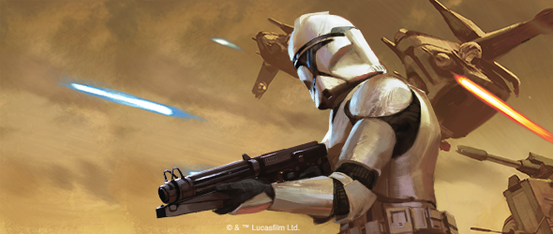 Star Wars: The Clone Wars (Set in Timothy Zahn’s universe)
Zarah was trapped. The clone stormtroopers were closing in on her, stalking down the narrow ravine, heavy boots pounding against the forest flooring. To her back was a solid wall of earth, too slippery to climb. Her lightsaber was gone, lost several yards away when the stray blast had knocked it from her hand and what was worse, she could no longer feel the Force. It was as though someone had dropped and iron curtain between her and it and the loss was as keen as parting with a limb. Only one thing could cause that sensation and a specimen of it was inching along a branch a yard out of her reach – Ysalami. The troops came into view. “There she is!” Four blasters raised, their barrels glinting dully in the light. Zarah stopped and turned. If she died today, so be it – but she would not die a coward, trying to run away from – “Hey, you guys!” The shout came from above. Heads turned, Zarah’s included. She just had time to make out a stocky man, dressed in a green leather jacket and wearing a heavy pack on his back. He waved to them and suddenly Zarah realized that he was holding her lightsaber. “What the…?” But she never got a chance to finish. The man jumped off the cliff. His pack ignited at the same time as the lightsaber. The troop commander shouted a warning, but he wasn’t fast enough. The man was nimble and quick and the lightsaber flashed. In a second, the troopers were on the ground and the man was landing in front of her, grinning like he’d just won first place in a speeder race. “I think this is yours,” he said, handing the lightsaber over with a flourish. She took it, stunned, and looked up into a pair of laughing brown eyes. “Who are you?” she asked. “Graham,” he said, as though she should already know the name. “Dan Graham. And it looks like someone needs a lift out of here.” Writing Exercise: the Woman in Waiting (an historical romance introduction, starring Kyra Morales)3/27/2020 My friend, Kyra, not only has an awesome last name, but is also an artist with a romantic soul, so this seemed the perfect setting for her. It's another story that leaves me really hoping for a happy ending! (Note: the accompanying image doesn't perfectly capture the mood of this piece, but it got pretty close.)  She was sitting on the rocky promontory over looking the harbor and the forest of masts that moved in and out of the busy port. Her dark, curly hair was loose and danced in the wind. She was dressed in white and sat in deep thought, chin in hand, her sketch book forgotten at her side.
I knew her at once: Kyra Morales, only daughter and heiress of the powerful Morales clan, the one who'd had the misfortune to fall in love with a penniless sailor. Her father had driven him off, of course, but rumor had it that the sailor wasn't dissuaded, that he'd gone into the spice trade and vowed to return to her side. Perhaps it was true, though I though it very unlikely. Still, here she sat, watching the ships and fingering the crucifix that she wore around her neck. She did not look like a disappointed woman - she looked like someone who daily expected her ship to come in. She spotted me then and stood, brushing the twigs from her skirt. "Lovely day," I said. Her laughing brown eyes met mine. "Its beautiful," she agreed. "It's the sort of day that makes you believe in happily ever after, isn't it?"  To quote Magnum, PI: "Now, I know what you're thinking. And you'd be right! Only..." One of the most common pieces of writing advice I've heard is this: You need a Killer First Line, one that will hook the reader, be he/she an editor, an agent, your best friend, a stranger in Barnes and Noble, or even your mom. A Killer First Line grabs the reader's attention and pulls them, helplessly into your story, ensuring that they will read the second line. A Killer First Line sets up the rest of your book. And there's always the hope that if you nail that Killer First Line, it's going to be gracing blog posts and articles about writing from here until the end of time. Needless to say, there is a TON riding on your first line. So much so, that you can spend hours, days, sometimes even weeks tinkering with the line, loving the line, hating the line, re-writing the line again and again, getting caught like a fish on a... line (see what I did there? :) ). It's daunting, that Killer First Line. It can even be debilitating. Which is why I recommend that you completely ignore the Killer First Line. "WHAT?!" You exclaim. "Ignore the first line and lose out on fame and fortune and retweets? Are you insane?" No, I'm not (or at least this isn't proof of it). I'm not saying never address the Killer First Line. I'm saying ignore it for your first draft. Maybe even your second or your third draft. Leave it alone - write a place-holder line and then ignore the stupid thing. Write the book first. Then write the first line.  I know this sounds backwards, but I actually have some good reasons to suggest this: the first being, if you choke up on the first line, you'll never finish the book. Trust me, I've been there before. I concentrated so hard on one stupid sentence, a sentence I couldn't conquer, that I lost interest in the book and faith in myself and the story died on the vine. Tragic, I know, but I recovered. But the more important reason is the second one: Until you've written the book, you don't really know what it's about. Stories are funny things. You set up a scenario, you find your characters and your settings, you outline, and you begin. You think you have it all worked out until suddenly, magic happens, the story twists, and you find yourself in a place you never expected. Or, the story turns out somewhat like you'd originally imagined, but halfway through the story, you realized a deeper meaning to the story or the characters. This is the good stuff, these unexpected treasures. Second drafts were made to expound on them, take advantage of them, and pare away the dross of unneeded prose so that the shining gold of your discovery can be made visible. And once you find the gold, bam! There's your Killer First Line. That's not to say that your Killer First Line is going to be any easier to write in draft three. Most likely, it'll be just a tricky. But at least then you'll know what story your actually setting up, the true story, the story that lay buried deep within your initial outline (or in your imagination, if your pantser). The moral of this story? Killer First Lines are amazing, but they aren't actually the first thing. Your story is. Without the story, without the book itself, the Killer First Line is really just a line, a throw-away that means little without the bigger story to back it. So write your story first and the Killer First Line will follow. It's practically a guarantee. Agree? Disagree? Have a better idea? Comment below and let me know what you think!
I first met Derek Foley when Terry brought him on the Early Late Night Live Show as co-host and it quickly became apparent that we had a lot in common, including a love of Star Trek. (Though he's prefers Picard and I'll always choose Kirk.) A pool player and organizer of Super Megafest, Derek's intro was an easy and fun one to write. Enjoy and let me know what you think!  Star Trek – TOS:
Captain’s Log, supplemental: On a mission from Star Fleet to bring back a piece of stolen technology, Mr. Spock and I find ourselves trapped behind the Neutral Zone in a small Romulan frontier town called Sargon’s Waste. We have the technology, but our ship has been destroyed. Thanks to Spock’s quick thinking and Vulcan resemblance to Romulans, we’ve not been discovered yet. Time is running out and we find ourselves in need of a ship and a pilot. We’ve been directed to Garak’s Tavern and told to ask for a man named Foley, who won’t ask too many questions… Garak’s was like any other tavern on the outskirts of any other civilization: run-down and tense, with representatives from every corner of the galaxy. The people who congregated at these places only had two things in common: a love for alcohol and the desire to be anywhere but home. The Vulcan was adapt at many forms of communication, but the tavern was clearly out of his depth. He hesitated in the doorway and Kirk, breathing easier in an atmosphere he understood, nudged him gently. “In the corner,” he murmured. They weren’t the only anomaly in the bar that night. A human stood bent over a game table, a game that reminded Kirk strongly of pool, though this one was played with holographic tribbles that were hit into the mouths of crocodile-like creatures. As they approached, the human sunk a shot and, looking pleased, stepped around to set up his next move. “Are you Foley?” Spock asked. The human glanced up at him. He was sturdily built, with short cropped hair, and, unlike most of Garak’s patrons, clean shaven. “Depends on who’s asking,” Foley said, and turned back to the table. His cue stick struck with practiced efficiency and the hologram tribble squealed as it disappeared into the crocodile’s maw. Foley grunted with satisfaction and straightened up. “If you’re looking for a pilot, I might be available.” “Nice shot,” Kirk said. Foley glanced at him and grinned a lopsided grin. “I hate tribbles,” he said with simple sincerity. In that instant, Kirk knew that they’d found their man. In this writing exercise, I'm using my friend, Jen Robidoux, as my avatar. She's a soft-spoken, gentle woman who never-the-less is a fierce protector of the defenseless and the under-dog. This is just a snippet of a story but seriously? I want to know what happens next!  "Are you... Richard McCallum?"
Rick lowered the whisky glass and squinted in the bright desert sun. His vision, which was decent, had necessarily shortened as he drank his way through the dry heat of the afternoon. A woman stood in front of him, dressed in a stylish flowered blue dress and a straw hat. Her brown hair was cut in a bob and she carried a battered leather suitcase in one hand and a handwritten note in the other. He couldn't help but notice that she had the kindest eyes he'd ever seen. Those eyes were studying him, trying to size him up. His five o'clock shadow had lengthened to the beginnings of a true beard and his khaki colored clothes were wrinkled for having been slept in. He looked awful, truth be told, and being broke, he thought it was an accurate representation and a safer one in a town this tough. The only thing he owned worth stealing was his plane, his father's old watch, and, maybe, his leather jacket. Not that he'd let that happen. He brought his glass to his mouth to take another swig, thought the better of it, and asked instead, "Who's asking?" "My name is Jennifer Robidoux. I sent you a telegram, inquiring about your services." "Wait..." he staggered to his feet. "You're the woman who needs a pilot to fly you across the desert on some crazy treasure hunt? With the whole world about ready to go to war? Are you nuts, lady? Go home, stay home, where it's safe." That was the wrong thing to say. Her eyes narrowed and her shoulders squared. "I'm not going after some foolish treasure, Mr. McCallum, and I'm well aware of the state of the world. My father's gone missing. And I need your help to find him." 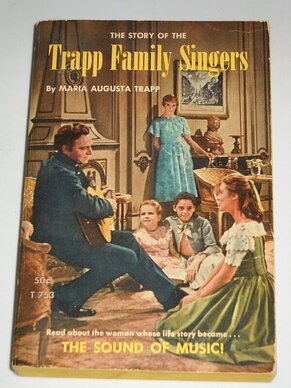 Early in her book, The Story of the Trapp Family Singers, Maria von Trapp (as she was known then - they dropped the "von" when they became American citizens) recounted her early married life. It was one of wealthy, ease, and loving cosiness until one day, because Georg's generous effort to help a friend, they were financially ruined. It was a humiliating experience. The once proud aristocratic Captain was forced to let go servants, curb his lifestyle, and even rent out rooms in his magnificent house to keep the roof over his family's head. Lucky for him, he'd had the good sense to marry Maria. Maria marshaled the efforts, took on poverty, and with her wily cunning and fearless faith, turned a family hobby into a world-wide success. But before all of that, when they were still merely the Von Trapps, who had fallen into hard times, she kept her husband's spirits up with her pragmatism and clear-eyed vision. The children followed her example, making the best out of their new circumstances and astonishing everyone with their flexibility and lack of arrogance. "Imagine," Maria marveled her husband, "if we hadn't had this disaster, we never would have known what fine fellows the children are!" I read that book way back when I was 16 and that comment stuck with me ever since. Without the crisis, they wouldn't have known their own mettle. Right now, across the nation, we are closing ranks and doors, hoping to keep the Coronavirus (or COVID-19) at bay. We are doing so without marshal law, without fighting, and really, with very little panic. On social media, people are starting groups designed to connect people during this time of isolation, whether for financial help, physical help, or just for community. People are losing jobs and income and yet you hear very little complaining. The Dropkick Murphys did a free online concert that broke records. Stores are adjusting their hours in consideration of the elderly, food delivery services are dropping their commissions, and those in quarantine are serenading their neighbors. We don't know how long this social distancing will last here in the US. We don't know how this pandemic is going to end. But we never knew what fine fellows we could be until disaster struck. And that is something really worth knowing. Hang in there, friends! The best days are yet to come! FREE BOOKS!
Every once in a while, I put out a call on Facebook, asking for volunteers for a writing exercise, in which I introduce my friends in novel form. Chris Dubey runs an ambulance company in Berlin, NH, in addition to being a talented actor who wrote and produced his own movie. Though he often plays a villain (he plays my evil boss in the movie Chance), his life work is quite the opposite, hence, this scene. Enjoy and let me know what you think!  John hit the wall and scrambled up, but he was too late. They were on him diseased hands grabbing at his legs, guttural sounds of animal-like triumph ringing through the air. John screamed, kicked, and tried to pull himself up, hands desperately grasping at the rough wall, but he was failing, falling, when...
Suddenly, hands grabbed his own, pulling him up and over the wall, out of their grasp. The diseased fell away and a wail of dismay rose up from the crowd. John was on his back, gasping. The wall arced up over him, casting a shadow. As he watched, he saw movement along the edge. A hand, withered and stricken with the disease, grasped the edge and began to pull. They were coming. Someone was hauling him up to his feet. “Come on!” John obeyed. He and his rescuer ran through empty streets, where the corpses of old cars, long out of fuel and stripped of anything that could be a use, lay haphazardly on the sidewalk. Buildings, boarded up and laced with barbed wire, loomed up over them. The air echoed with the sounds of their shoes clattering on the pavement. It was eerily silent, broken only by the occasional shout from behind them. They were coming. The man in front was tall and ran with long, easy strides, his AR-15 slung across his back, long hair swinging with the movement. He looked back only once to see if John was following. “Keep it up!” John did, though his lungs were burning and his legs were so weak that it felt as though he were running through wet sand. They turned a corner and John saw a clearing, where several buildings had been leveled to clear a block around a single building, tall and armored. It was to this that his unknown rescuer ran. “Come on!” They ran and the man shouted. Someone from within answered and a rope ladder dropped from several stories up. They climbed and when they were halfway, they heard another shout and shots rang out. The enemies, the diseased, were coming, lurching as they made their way across the open spaces. The bullets only slowed them, ripping at their decaying flesh, but it did not stop them. John finally reached the top of the ladder, falling to the ground as the alarm grew and more men and women rushed to ward off the invaders. As he lay, gasping, on the ground, the man with the long hair crouched in front of him and grinned. “You can breath now, soldier,” he said. “My name's Chris. Welcome to the Sanctuary.” Writing Exercise: Enter The Tall, Cool Brunette (a 1940s detective noir intro for Margaret Traynor)3/9/2020 I actually had three character intros in mind for my sister, Margaret Traynor, but this, with its old-school and sardonic feel with a flip, seemed the funniest. She has a keen sense of humor and her stories, when not spooky, lean towards the farcical. Enjoy and let me know what you think of this intro! 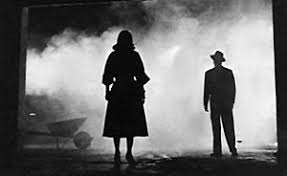 It was 9 o’clock on one of those heavy kind nights when the sound of the city make you feel lonely and surrounded all at the same time. I sat at my desk, finishing off a bottle and trying to make myself comfortable in a chair that was one step below an electric one for comfort. I would have stretched out on the couch, but it now was adorning my landlord’s parlor as part of last month's rent. Last month was a particularly bad one. I'd spent a week in jail after a falling out: my client wanted the evidence to leave her cheating husband, he objected to my aiding her, and Mickey's Place got smashed up in the ensuing disagreement. No one said being a detective was easy.
I was just reaching into the desk for my old friend, Jack Daniels, when I heard a sound at the door – a gentle rapping sound of a small gloved hand. I moved from Daniels to Colt and bid the stranger enter. A tall, cool brunette glided the room. Either she had money or access to it, because the pearls, the silk, and the flowered perfume she wore were the real stuff. She held herself like a queen, pale and graceful, but when her eyes, large and brown as dark chocolate, found mine, I knew this kid was in trouble. “Excuse me,” she said, in a soft voice. “I’m Traynor, Margaret Traynor, and I need your help.” She sounded sincere, but I’d been burnt too many times to fall for another pretty face. I sat up in my chair and gave it to her straight. “Sure, sure,” I said. “That what they all say, sister. But listen here: I’m Nick Powell, private detective, just like it says on the wall. I’m for hire, but I’m no one’s patsy or fall guy. If you want me to take out the bad guys or get you out of a jam, I’m your man, but if you are thinking you can play me for a sucker or try to pull a scam on me, I’ll warn you right now – ” I dropped the Colt on the desk in front of me “- it won’t end well.” The woman looked at me, her eyes as wide as saucers. “Good heavens,” she said. “You are a tough guy.” “I am.” “No one can fool you.” “Nope." "I've come to the right place. I feel safer already." Her admiration was starting to grate on me. "Tell me what you want, sister, and make it snappy. I have an appointment.” Then, incredibly, her mouth curved into what I swore was restrained laughter. “I was just wondering,” she said, “if you could direct me to the law offices Howard, Fine, and Howard? I was told they were on this floor.”
By Andrew Klavan
Did that really just happened? Has he gone insane? Was it all a dream? Did he have a brain tumor? Desperate for answers, Austin sets out to find them and discovers that the mystery can only be unlocked by a strange piece of fiction that holds the truth about the magical kingdom. But he isn’t the only person searching for the missing manuscript, and his rivals will stop at nothing to get it first. To complicate matters more, Austin soon discovers that he has no control over when he passes between worlds, and finds himself out of trust for even the simple things, like walking through doorways.
Stuck between dual realities –charged for a murder he doesn’t recall in one and running from a maniacal billionaire who’s determined to kill him in another– Austin’s monotonous life has become an epic adventure of magic, murder, and political intrigue in both the New Republic of Galiana and the streets of Los Angeles California.
Klavan breathes fresh life into the fantasy and noir genres by combining the two in this killer thriller. Austin Lively is a failing Hollywood writer, being slowly crushed by his own failings and losing his faith in humanity (his faith in anything higher is already gone). When he's thrust into another world of magic and assumed to be a knightly hero, his vision of the world - and himself - is challenged to say the least. But can he stay alive long enough in either world to find the answers he so desperately needs?
Written with wry humor and a keen sense of boyish adventure, Another Kingdom combines the best of both fantasy and noir. Klavan's own joyous faith, cheerful philosophy, and optimism is infused through-out (word of caution - while he is a Christian, those expecting a squeaky clean read will be... challenged here) and the story moves with the swiftness of a blockbuster adventure. While those seeking a fantasy epic - long, replete with detail - might find this too swift to be satisfying, readers looking for a tale of mystery, derring-do, romance, and swashbuckling (think sarcastic Sabatini) will be more than satisfied. Very highly recommended. (Note: this is the first in a series, so expect a cliff-hanger!) My brother, Spencer, loves all things western, especially when they're detective shows set (better still if created in) the 1970s. Think Rockford Files. The fact that Spencer actually owns and frequently wears a cowboy hat (despite having never left New England) made this an easy intro to write.  The biker leaned over me, his hot breath fanning my face. I was still reeling from the car accident and my eyes hadn’t yet adjusted to the burning desert sun. The dust was thick, choking my throat, rasping at the throats of the jeering, cat-calling crowd that surrounded me and Julie. Julie was whimpering – but with two men pinning my arms and the third demanding money I didn’t have, there was little I could do.
“I said, you gotta pay the toll, man,” the biker said. He leaned in closer, his leering face inches from my own. “You gotta pay.” “I haven’t got anything,” I rasped and grunted when someone jammed a fist into my ribs. “Well now, ain’t that just too bad?” the biker said and he stepped back. “All right, boys…” He never got a chance to finish. There was the roar of an over-sized engine, a squeal of tires, a cloud of red-tinged dust, and then, most ominously of all, the booming shock of a shot-gun, fired close by. The dust settled around an enormous pickup truck. A tall, rangy man with a battered jacket, a cowboy hat, and a tin star stood in the doorway of the cab. He held the shot-gun like it was a part of his arm and his dark brown eyes scanned the crowd as he chewed slowly on a wad of tobacco. “Party’s over, boys,” Sheriff Traynor said and adjusted the shot-gun ever so slightly. “I think you all better go on home now.”  Today is Ash Wednesday, the beginning of Lent, the Catholic Church's 40-day season of fasting, alms giving, and prayer in preparation of Holy Week and Easter. Today, we are marked with ashes and reminded: "Dust you are and to dust you shall return." It's easy to get caught up in the gloominess of that sentiment and, indeed, in the penitential rites and rituals that fuel this particular season (Fridays are the worst for a meat-lover like me!). After all, sacrifices, even voluntary ones, are often uncomfortable and prayer, and contemplation tends reminds us of how small, how dust-like, we really are. But the second reading today reminds us not to limit our vision. We may be small, but we are loved immeasurably. We may be limited, but God is not. We may not feel like we're worth much, but God gave Himself through His Son to ensure our future happiness. We may be dust, indeed, but we are dust that are loved beyond all measure. So take up your cross and remember: the battle is already won and the best is yet to come. Today's Second Reading:
2nd Corinthians 5:20 - 6:2 So we are ambassadors for Christ, as if God were appealing through us. We implore you on behalf of Christ, be reconciled to God. For our sake He made Him to be sin who did not know sin, so that we might become the righteousness of God in Him. Working together, then, we appeal to you not to receive the grace of God in vain. For He says, “In an acceptable time I heard you, and on the day of salvation I helped you.” Behold, now is a very acceptable time; behold, now is the day of salvation.  Sarah Levesque Sarah Levesque One of the very first character intros I ever did was for my friend, Sarah Levesque, a fellow writer of fantasy, knower of all things Tolkien, and editor of the online magazine, LogoSophia. She's been begging me to give her another intro, but I still have a partiality to this one, which focuses on her no-nonsense, yet fun-loving approach to life. Enjoy and let me know what you think! (Note: I know the girl in the graphic is wearing red, not green, but, alas, I have not the skills to change the color of the image!)  “…and then, after you offer them the berries, you step back three paces, bow…” here, our would-be-guide to the Elven kingdom took three very unstable steps backward and awkwardly bowed. The mead in his mug slopped dangerously, but he was a practiced drunk and not a drop was lost.
“Then,” he said, his one-eye gleaming over the prodigious growth of beard and longish nose, “you say ‘tshne Arwen ithmas’. That completes the charm.” Ren and I exchanged doubtful glances. All we'd asked was for directions through the Dark Wood to the Elven kingdom on the other side. We'd known it to be dangerous and expected there to be some level of elvish nonsensical hoops to jump through, but this man's explanation long-winded, excessively detailed instructions even our expectations. It was, to say the least, a daunting prospect. “And that’s how you obtain passage through the Dark Wood?” Ren asked. Concern creased his face. I knew what he was thinking, because it was the same thought I was having: going through the Dark Wood was bad enough. There was no way the pair of us could magick our way past barriers as well. Our mission was over before it began. Our cheerful informant didn't appear to notice our distress. “Oh sure.” He nodded confidently as he carefully retook his seat. “Manys the time I’ve been in the forest, drinking their wine, making small talk with the…” “…weasels.” A new voice erupted from very close beside me, making me jump nervously. “Wesley, you just made all of that up.” Ren and I turned. Beside me stood a young woman, dressed in a practical green dress and a tan bonnet. She had the air of amused, but strained patience, and she stood with her hands on her hips. Though she was scarcely taller than I was seated, she commanded both the room and the liar we’d been speaking to. The one-eyed man turned pale and his massive frame seem to shrivel before our eyes. “Aww, but Sarah…” he complained, but she would have none of it. “If you want work, Wesley,” she said, “my father has wood that needs chopping out back.” There was a moment's stand off, where the large drunk with the untidy beard debated his chances against the tiny girl with the confident stance. In the end, her determined stance won. He slunk away, defeated, to go chop wood. The girl, Sarah, turned to face us. “I wouldn’t take anything he says seriously," she said. She'd relaxed and her manner was practical and efficient. This was her domain and she ruled it well. "Wesley means no harm, but go with him and he'll get you into more trouble than he could handle and charge you double the fair rate to boot." "Right," said Ren, sounding as flummoxed as I did. She eyed us both carefully. "But if you need a guide to get you through the woods, I can do it. And you won’t need any magical mumbo-jumbo to get there, either.”
By Greer Hendricks and Sarah Pekkanen
Cassandra and Jane live a life of glamorous perfection, and always get what they desire. When they invite Shay into their circle, everything seems to get better. Shay would die for them to like her. She may have to.
REVIEW:
Hendricks and Pekkanen deliver another nail-biting, twisty mystery with a heavy dose of upper-class New York style for good measure. This thriller is fun, fast-paced, and absolutely riveting, but the back cover copy does the story little justice. Shay is a data-minded loner who, while on her way to an job interview, witnesses a young woman's suicide. That's enough to ruin anyone's week, but Shay has also just lost her job, her crush, and her apartment. Desperate to find out more about the mysterious woman, she goes to her wake and discovers the Moore sisters and their tight group of friends. The Moores welcome the achingly lonely Shay into their circle... but not without an agenda. Soon, Shay finds herself caught in a web of intrigue, one that may cost her life - or more. As I said, this is a fun thriller that's a lot lighter than these authors' previous outings (domestic violence is difficult to stomach and this book has none of that). The main character is a sympathetic mess, the main villains pleasingly calculating and clever, and the pacing is quick enough that you can read this in an afternoon or two. Will it rock your world? Probably not. Is it fun escapism? Absolutely. As such, its highly recommended. Every once in a while, I post on my Facebook page, asking friends and strangers for volunteers in a writing exercise. Essentially, I write an intro for them into a non-existent novel. It's a fun exercise for me, as I try to use what I know about the person to inform, not only their entrance, but the style of the book or story that I think they'd best suit. Radio personality, rocker, and actor Jeff "Skumpi" Lorenz (check out his band here) graciously allowed me to use his likeness in this, a scene from a Revolutionary War epic. Be sure to let me know what you think! 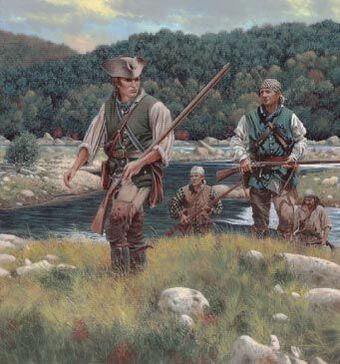 Dawn came and the first reports started to filter in – there’d been a shooting in Lexington. People had died and the lobsterbacks were moving on Concord. My mother was visibly trembling, but she was determined she wouldn’t leave our tavern and farm for the troops to sack on their return. She opened as usual, but the only person who stopped by was a woodsman, tall, gray-haired, dressed in worn buckskin and carrying the longest musket I’d ever seen. He ordered a cider and then took a seat in the corner. He was asleep before I could bring the cider to him.
We knew that the British were retreating long before they came. They were falling back to Boston empty-handed and the militia was following them. Neighbors came to warn us. My mother closed up the tavern, took up her musket, and warned us to stay out of sight. The troops that returned from Concord weren’t the same men that had passed our house that morning. They were bloodied and bedraggled, angry and frightened, exhausted and jumpy. The first group passed our tavern, stopping only to bang upon the door. We kept quiet and they passed on. We could hear shots now, growing closer and closer. The frightened murmurs became roars. The banging on our door became more insistent. By the time the last group of soldiers arrived, it had become battery. We remained behind the counter, frightened and watching my mother. It was only when the redcoats shouted, “Let’s burn it down!” that she stepped up from behind the counter and opened the door. “My children are in here…” she said, but she didn’t get a chance to finish. The soldiers shoved her aside and stormed into the tavern. One of them grabbed her by the arm and dragged her along with them. “Let me go!” she exclaimed and for the first time in my life, I heard fear in my mother’s voice. Two were holding my mother. Another three were tearing their way through our supplies. From outside, I could hear the sound of the militia, yelling and frightening, but still too far away to help us. I hopped up from behind the counter and charged the soldiers. “Let her go!” I exclaimed, with all the fury a twelve-year-old could muster. I slammed into one of them, only to have another soldier pluck me up and heft me across the room. I hit the floor hard, all the air knocked out of my chest. “Cockroach,” he spat and turned back to my mother. He didn’t see the swinging musket until it was too late. It hit him on the head with a sickening crack and he was down and out. We’d all forgotten about the woodsman. With a roar that shook the rafters, he tore through the soldiers like a demon, using his big musket like a club. It was five to one, but they didn’t have a chance. Two more dropped, the third pulled a knife but didn’t last long. The last soldier simply ran out the door and abandoned his fellows. I lay on my back, watching the big man move like a blur of tan buckskin. When it was all over, he turned to me and offered me a hand up. “You’ve got spirit, son,” he said. “I like your courage.” His blue eyes were bright. After all that work, he was barely winded at all. “Who-who are you?” I asked. “Names Lorenz,” he said. “But you can call me Skumpi, son.” |
The BlogWelcome to 
Categories
All
|



Copyright © Killarney Traynor
All Rights Reserved.
No part of this website may be reproduced without
the Owner's express consent. [Backlinks allowed.]
All Rights Reserved.
No part of this website may be reproduced without
the Owner's express consent. [Backlinks allowed.]